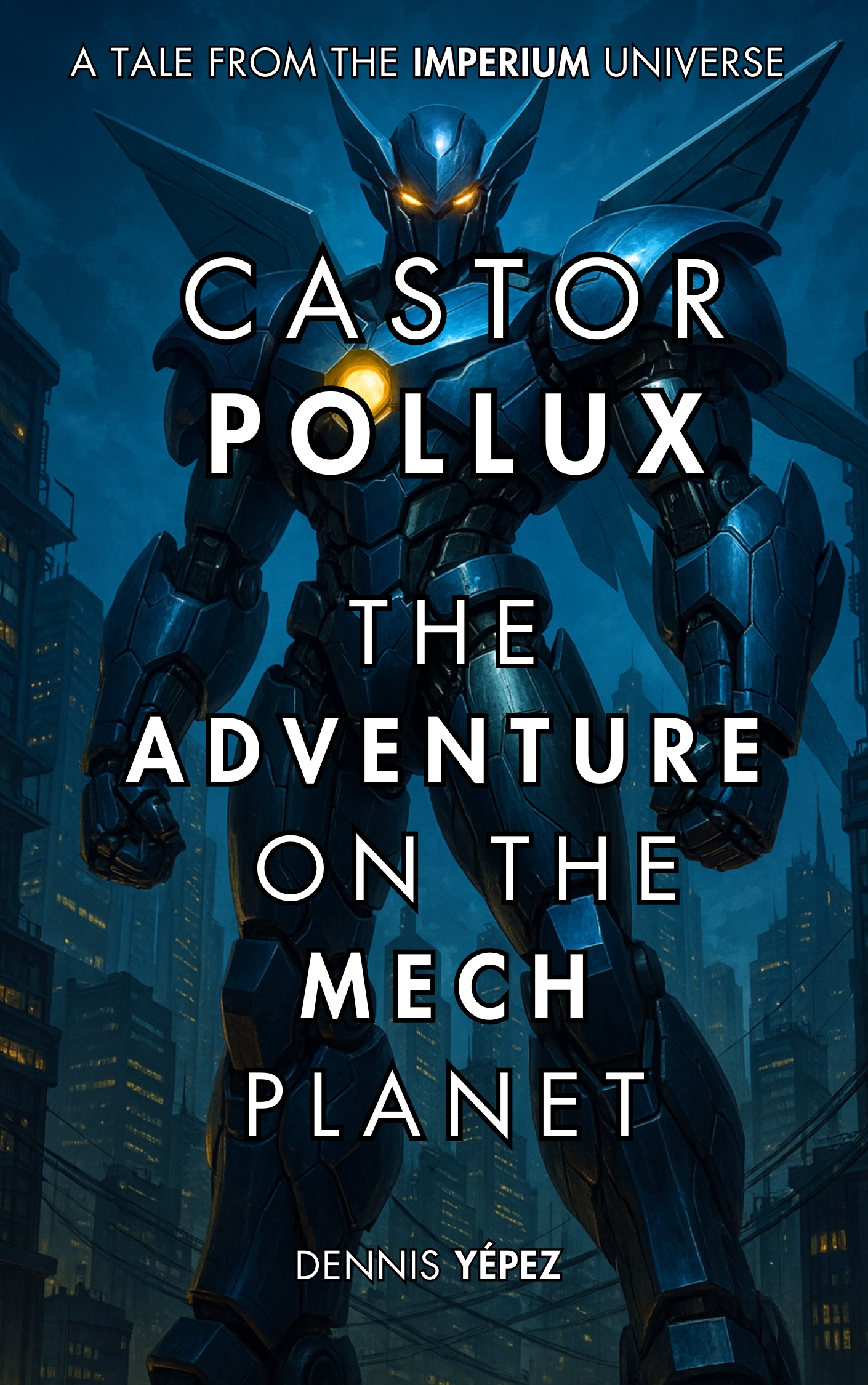
CASTOR POLLUX: THE ADVENTURE ON THE MECH PLANET
Un relato del universo Imperium
¡La acción continua!
A planet on the brink of collapse.
A war no one can stop.
And a machine that has crossed a dangerous line.
Castor Pollux arrives on a world that still believes it has a hero. A celebrated champion. An invincible pilot. Until the battle changes and victory is no longer an option.
Something new has appeared on the battlefield.
Something that learns.
Something that does not need a pilot.
As the city falls and traditional defenses fail, Castor realizes this is not a war to be won through strength or speed. The only way forward is to endure.
But the only option is an ancient, obsolete, and dangerous mecha.
A machine never designed to shield its pilot from pain.
A short story written in the tradition of Golden Age pulp science fiction magazines. Fast, explosive, and action packed, meant to be read in one sitting and told with a cinematic style.
Each Castor Pollux adventure stands alone, yet all are part of the greater Imperium universe.
War has changed.
How far can a hero go when winning is no longer possible?
CHAPTER 1
THE PLANET’S CHAMPION
The Centurion 1 descended calmly over Shōkai, following a clean and orderly approach trajectory. There were no alarms, no immediate signs of danger. They had arrived by direct invitation from Professor Ishida, an old colleague and personal friend of Professor Quintus. The mission, in theory, was simple: an academic visit, technological observation, and exchange of information. Nothing more.
The calm lasted exactly three seconds.
“Visual contact,” Aurora reported in her usual neutral, precise tone. “Sudden emergence of large-scale combat structure.”
In front of them, a giant mech emerged out of nowhere, tearing through the urban sky like a mechanical deity descending to reclaim its territory. Castor Pollux reacted on pure instinct. He twisted the controls with brutal precision, veering off course at the last possible second. The Centurion 1 responded with a deep groan as it plunged between columns of fire and suspended debris. The air vibrated. The hull creaked under the strain.
The city unfolded beneath them like a shattered board: avenues split open like scars, towers collapsed, entire districts reduced to smoking ruins. And then, as they completed the turn, they saw it clearly.
It wasn’t one.
It was two.
Two colossal mechs, facing each other, measuring like ancient beasts before the final clash. And the Centurion 1 was directly between them.
“What the hell is that…?” Bellatrix asked, unable to hide her astonishment.
“Combat mechs,” Professor Quintus replied, already sweating. “Heavy war platforms…”
“Terran…” Lotus growled, gripping his harness. “Be careful, or you’ll get us killed.”
Castor didn’t answer. He adjusted lateral thrust and let the ship glide dangerously close to the battle, cutting through the shockwave of a recent impact. Incandescent metal fragments scraped past the hull.
“Warning,” Aurora said. “Zone saturated with heavy weaponry. Maneuver margin: six percent.”
“Enough,” Castor replied without looking away.
Below, the enemy mech advanced first. Its arm opened in sections, revealing a short-range particle cannon. The blast tore through an entire façade before sweeping across the avenue, vaporizing concrete and steel as if they were paper.
“Concentrated energy attack,” Ishida called out from the command center. “Particle cannon. Frontal discharge.”
Hirachi did not retreat. He activated directional shielding, absorbed the energy, and rotated on his axis with near elegance. The impact dissipated across the imperial mech’s outer layers, releasing a brief but controlled glow.
At the side of the central table, Commander Takeshi remained motionless, arms crossed, observing the projections without intervening. He did not correct the scientists. He did not rush them. He waited.
“Perfect force redistribution…” Quintus murmured. “He wastes nothing.”
But the giant was not finished. One of its sensors shifted. Its systems recalculated. Then it looked upward.
“Castor…” Aurora warned. “Enemy vector shift. Partial lock on the Centurion 1.”
“I see it.”
The mech’s cannon rotated slightly. It did not aim at the champion.
It aimed at the ship.
“Secondary attack incoming!” Ishida continued. “Sweep discharge.”
Castor reacted before the sentence was finished. He shoved the controls downward, cut main power, and let the Centurion 1 drop in controlled freefall. The particle beam passed through the space they had occupied a second earlier, vaporizing a communications tower.
“That would’ve split us in two!” Lotus roared.
“Not today,” Castor replied.
He activated reverse thrust, rolled the ship on its axis, and sent it between the legs of the two colossi, using their mass as cover.
“Mass-shadow concealment maneuver,” Aurora reported. “Elevated structural risk.”
Castor answered with a faint smile.
Below, the enemy launched a heavy anchoring harpoon, attempting to immobilize Hirachi.
“Incoming restraint. Containment harpoon,” Ishida confirmed.
Hirachi responded with assisted lateral thrust, severing the cable with an energized wrist blade and closing distance in the same motion.
Hirachi’s strike was kinetic, direct to the torso. It did not aim to destroy—it aimed to destabilize. The ground gave way under the impact. The opponent staggered… and adapted. Its shoulders opened, releasing a guided micro-missile swarm that saturated the air.
“Incoming swarm,” Ishida continued.
The missiles did not distinguish targets.
“Multiple trajectories,” Aurora warned. “Probable impact on the Centurion.”
Castor forced an asymmetric roll, disabled one stabilizer, and let the ship skid laterally while the system compensated at the last second. Two missiles exploded near the hull; one grazed the shield and made it flicker.
“Shields at seventy-one percent.”
“They’ll hold.”
Hirachi activated automatic point-defense. The projectiles headed toward the imperial mech exploded before reaching the armor, illuminating the city like an artificial dawn. From the avenues and balconies, the crowd shouted in euphoria. The giant screens—always active in Shōkai—multiplied the image of the combat in every district, while broadcast drones hovered around the colossi, recording everything. Here, even destruction had an audience. The battle was not only war—it was spectacle.
“Civil transmission active,” Aurora reported. “Full planetary audience.”
“Perfect,” Lotus growled. “Let’s get killed with a crowd watching.”
The enemy mech attempted its last resort: an unstable plasma discharge, lacking fine control, designed for massive damage.
“Unstabilized plasma,” Ishida called out. “Risk of self-collapse.”
The plasma expanded and grazed the Centurion 1. The ship vibrated violently.
“External temperature rising,” Aurora warned. “Immediate withdrawal recommended.”
Castor lifted the ship, pulling it out of the thermal cone by inches, holding position as Hirachi advanced through the plasma, sustaining superficial damage. Then he executed the final sequence: a kinetic strike to the power module, a torsion rotation to open the armor, and a direct penetration with a short-range energy weapon.
The eastern central system collapsed. It did not explode. It did not scream. It shut down.
For one eternal second, the mech remained standing… and then it fell.
Silence.
Then the planet roared.
The giant screens, already lit, multiplied the scene across every district. Celebratory sirens pierced the city. The drones continued transmitting. Hirachi’s name was chanted like a collective oath.
“Threat neutralized,” Aurora confirmed. “No active hostile signals detected.”
Castor reduced power. The Centurion 1 remained suspended above the devastated city, hovering between smoke and flickering lights. Below, the imperial mech stood upright, motionless, dominating the landscape like a statue of war.
“Priority channel incoming,” Aurora announced. “Unidentified signal. Origin: imperial mech.”
Castor accepted the transmission.
The champion’s face appeared on the cockpit screens, still covered by the pilot’s helmet. The visor reflected emergency lights and residual flashes from the battle. Behind him, the interior of the mech vibrated with contained energy.
Hirachi did not greet them.
He observed the cockpit for several seconds, evaluating.
Castor noticed something before he spoke: the breathing behind the visor was too rapid for someone who had just won that cleanly. A faint fog formed and disappeared across the dark glass. For an instant, the champion did not look like a statue of war. He looked like someone catching his breath.
Then his jaw tightened.
And the voice that emerged was the correct one.
“Identify yourself,” he ordered at last.
Castor held his gaze without hesitation.
“Castor Pollux.”
A slight silence.
“Castor Pollux,” Hirachi repeated, as if filing the name away. “Next time, keep your ship out of the combat zone.”
Lotus released an immediate growl.
“Terran, tell him he nearly pulverized us.”
Castor did not take his eyes off the dark visor.
“We entered at the request of planetary command,” he replied calmly. “We did not interfere with your attack.”
Hirachi tilted his head slightly.
“You were crossing critical trajectories,” he replied. “And when I fight, I do not need distractions.”
A fraction of a second passed before he added:
“The entire planet was watching.”
It did not sound like vanity. It sounded like weight.
Quintus leaned forward, nervous.
“C-champion… we arrived by direct invitation from Professor Ishida,” he clarified. “Planetary command center. He requested our presence.”
Hirachi frowned briefly.
“Ishida?” he repeated. “I was not informed of external observers.”
“The authorization is valid,” Aurora intervened. “Confirmed by local protocol.”
Hirachi exhaled slowly. This time the exhalation was longer, less contained.
“Then maintain distance,” he said at last. “The spectacle is over. The threat has been eliminated.”
Castor held the silence a second longer than necessary.
“Understood.”
Hirachi gave a minimal nod.
“Good,” he concluded. “The planet needed to see this.”
The channel closed.
For a moment, Castor remained looking at the now-black screen.
He did not think, how arrogant.
He thought something else.
He thought that pilot fought as if he were not defending a city—
but holding up an expectation.
For several seconds, no one spoke in the cockpit.
“What an irritating type,” Lotus growled.
Castor observed the city through the viewport.
“For them, he just saved everything,” he said. “Let them admire him.”
Below, the imperial mech initiated its opening sequence. The hatches parted with a hydraulic hiss barely audible beneath the cheers. Hot vapor escaped from within as the hatch slowly descended, revealing the pilot’s silhouette. For a moment, the crowd fell silent, as if the entire planet held its breath.
No battle-hardened warrior emerged. No scarred veteran.
It was a boy.
No more than sixteen or seventeen. Slender, with still-youthful features, sweat-soaked hair clinging to his forehead. He walked unsteadily at first, disoriented by the light and the roar, as if he were still mentally stepping out of the cockpit. He blinked several times before focusing on his surroundings.
Then he understood.
He understood he was alive.
And that they were watching him.
He smiled.
It was not a calculated smile. It was wide, overflowing, almost childlike. He raised his fist in a practiced gesture, barely steady, still slightly awkward.
The crowd exploded.
The sound was physical—a wave of euphoria that even vibrated against the hull of the Centurion 1.
Castor said nothing at first. He watched the boy as technicians, officers, and civilians surrounded him, touching him as if he were a living relic. Hands on shoulders. Celebratory blows on the back. Voices shouting his name.
Bellatrix did not celebrate.
The change appeared first in her eyes.
Then in her jaw.
“He’s a child…” she murmured.
It was not surprise. It was rejection.
Lotus crossed his arms without looking away.
“That boy just brought down a mech like scrap.”
“That does not make him an adult,” Bellatrix replied without looking at him. “It makes him useful.”
The silence that followed was brief, but uncomfortable.
Castor activated the channel to the command center without taking his eyes off the pilot.
“Professor Ishida,” he said, “tell me something. Since when are you training adolescents to pilot war machines?”
A second of static preceded the response.
“We do not enlist them,” Takeshi said at last. “We form them.”
Castor turned his head slightly.
“And you are?”
“Commander Takeshi. Director of the defense program.”
“Form them for this?”
“In Shōkai, we train our pilots from a very early age,” Takeshi replied with measured calm. “Discipline. Emotional control. Neural synchronization. By the time they enter that cockpit, they are not children. They are symbols.”
Bellatrix gave a brief humorless laugh.
“Of course. It’s easier to send a symbol to die than a man.”
Takeshi did not respond.
Castor looked back at the boy, now lifted onto the shoulders of the crowd, flushed by the shouting, repeating gestures rehearsed before instructors and cameras. The boy searched for the giant screens, making sure his profile was properly framed.
He did not look like a soldier.
He looked like someone who had learned never to fail in front of millions.
“A symbol,” Castor repeated softly.
Then the crowd carried him back toward the center of the spectacle.
Castor closed the channel.
Bellatrix continued watching the scene, arms tense.
“They train heroes,” Castor said at last.
“No,” she corrected without taking her eyes off the boy. “They train sacrifices.”
No one replied.
And below, the planet continued celebrating.
Shōkai’s operations center did not.
Unlike the streets, where cheers still echoed endlessly, that room was filled with a tense, almost uncomfortable calm. Holographic screens suspended above the central space replayed the battle from multiple angles: impact trajectories, energy curves, reaction times measured to the millisecond. There was no music. No slogans. No heroic symbols. Only data. Cold. Persistent.
Professor Ishida stood beside the central table, hands clasped behind his back, eyes fixed on the projections. He was not smiling.
He asked them to rewind the sequence to ten seconds before the final impact, and the images complied. The enemy mech appeared receiving Hirachi’s decisive strike… but upon closer observation, it was evident something else had occurred at that exact moment.
Professor Quintus stepped forward cautiously, as if afraid to disturb something not yet fully understood. He adjusted a console, magnified a graph, and frowned.
The reaction times were changing. Not erratically, but progressively. That should not have been happening.
Bellatrix studied the projections with composed focus and asked what that variation meant.
Quintus took a second before answering. He swallowed before speaking. He explained that the enemy reacted late at first, but as the battle progressed, it began to anticipate. It adjusted mass, redistributed energy, corrected angles. It did not repeat mistakes.
Lotus crossed his arms, visibly uneasy, and asked whether that meant the thing was thinking while it fought.
Quintus slowly shook his head. It was not thinking, he explained—but it was not following a fixed pattern either. It was not a closed sequence.
Ishida nodded and added that it did not respond to any conventional artificial intelligence model or remote piloting system. There were internal signals that did not fit any known framework.
The screens shifted again. Irregular rhythms. Pulses that should not exist in a standard combat machine. Quintus pointed to a specific reading, and his voice dropped almost to a whisper when he mentioned active energy metabolism. That, he said, was biological.
Bellatrix slightly furrowed her brow. She asked if that implied the presence of a creature inside the machine.
Ishida replied that it might be something even more disturbing: a machine that had ceased to be only a machine.
That was when Hirachi entered the room.
He wore no armor or helmet, yet his presence seemed to shift the balance of the space. Some technicians stepped aside unconsciously. He advanced without stopping, with the certainty of someone who never doubts his place in the world, and declared that he had heard enough theories. The enemy had fallen. The planet was safe.
The second alarm was different from the first.
It did not erupt loudly nor provoke immediate panic. It was lower, more precise—a persistent pulse cutting through the remaining murmur of the command center. A technician noticed it first and looked up from his console, frowning. He reported a new signal—one that did not match the previous combat nor the remains of the defeated mech.
Commander Takeshi stepped forward to the central table and ordered the origin identified. The holographic screens shifted immediately. From a peripheral industrial zone, far from cameras and public view, something was emerging among collapsed structures. It did not walk or advance like a conventional machine. It rose, tearing layers of metal and concrete away as if they were disposable extensions of the environment.
Quintus observed in silence for a second before stating that it had not been there before.
The shape fully rose, and a murmur spread across the room. There were no clean lines, no recognizable symmetry. It was a hybrid structure—an amalgam of metal and organic tissue—reconfiguring itself in real time, adjusting volume and density as if responding to invisible stimuli. An operator confirmed visual contact and added that no known profile matched the entity.
At that instant, the priority channel opened without prior request. Hirachi’s voice came through, firm and immediate. He said he was already on his way.
His image appeared from inside the imperial mech. There was no public transmission yet, no audience, no trace of the spectacle from minutes earlier. Only determination. He added that this threat would end like the previous one.
Ishida attempted to interrupt him, pointing out that the readings did not match any prior pattern, but Hirachi cut him off with almost impatient certainty. It was larger, he said. Nothing more. Then he closed the channel.
Lotus exhaled sharply in contempt and muttered that this was not confidence—it was blindness.
On the battlefield, Hirachi advanced without hesitation. He opened with a heavy kinetic strike, a maneuver designed to test resistance rather than destroy. The impact shook the colossus… and did not penetrate. The entity responded in a way no manual accounted for. It absorbed part of the energy, redistributed mass, and rotated on its own axis with an unnatural, fluid motion—improper for a rigid mechanical structure.
Quintus barely managed to articulate that this was not mechanical behavior.
Hirachi then launched a directional photonic discharge. Ishida immediately identified it as a photonic beam, but the structure did not attempt to evade. It accepted it. The energy dispersed across its surface, reconfiguring internal layers, and the counterattack came from an impossible angle. The imperial mech was struck from the side with devastating force.
Technicians shouted that the shields were compromised.
Hirachi corrected posture and activated emergency thrusters with a determination that still seemed invincible. He responded with full force, driving the entire weight of his machine into the adversary. But the colossus was already prepared. It anticipated the movement, reconfigured its structure with impossible precision, and turned the counterattack into a sentence.
The next exchange was brief and brutal. The imperial mech was lifted from the ground as if it weighed nothing and hurled against a nearby industrial structure. The impact rippled through the command center like a dry tremor that shook consoles and tore strangled exclamations from the technicians.
Quintus whispered that it could not be.
Hirachi attempted to rise. The mech responded with an unsettling delay, as if some essential system had been altered within. Then one of the entity’s limbs closed around the imperial torso. It did not crush immediately. It adjusted pressure. Measured resistance. Calibrated.
Quintus understood what was happening before he dared say it: the entity was not merely attacking. It was studying.
When it finally compressed, readings spiked out of control and the screens flooded with red alerts. Operators announced that the pilot’s vital signals were dropping abruptly. Commander Takeshi ordered retreat with an urgency he had not shown before.
There was no response.
The giant released the body of the imperial mech. It fell sideways among dust and twisted metal. There was no heroic explosion. No spectacular flames. Only the dull sound of impact… and then silence.
The civilian transmission did not cut.
There was no censorship.
The camera did not search for a heroic angle because there was none. It captured the blow, the crack of armor, the fall—without music, without useful narration. For a second, the commentators said nothing. Not because they did not know what to say, but because for the first time the spectacle gave them no line.
That second became eternal.
In the command center, no one breathed.
Takeshi requested confirmation.
Ishida checked the readings. His hands trembled slightly. He took a moment before answering.
“There is no neural signal active.”
The commander closed his eyes for a second.
The system was inert. There was no active transmission. Vital signs had ceased.
The image remained frozen on the holographic screens: the imperial mech fallen, and the organic mech standing before the city, motionless, dominating the horizon with almost deliberate stillness.
Castor clenched his fists with contained force.
Hirachi was dead.
Shōkai had just lost its champion.Sobre esta serie:
Relatos cortos pulp dentro del universo Imperium.
Cada libro es una aventura autoconclusiva protagonizada por Castor Pollux en un planeta distinto, enfrentando nuevos enemigos, peligros y misterios. Puedes comenzar por cualquiera.